Burger Graphic Hamburger Art: Fast Food Design Assets
If you have ever tried to design a menu for a diner or create a flyer for a food truck, you know how difficult it is to find the right visual elements. Stock photography can be expensive and generic, and custom illustration takes time you might not have. This is where the Burger Graphic Hamburger Art Fast Food package comes into play. It serves as a versatile set of design assets that bridges the gap between professional illustration and practical application. It is not merely a collection of images; it is a toolkit for visual storytelling in the culinary niche.
The core appeal of this asset lies in its vector nature. When you work with raster images (like JPEGs or standard PNGs), you are limited by the resolution at which the image was created. Blow it up too much, and it gets pixelated. Shrink it down too much, and you lose detail. However, the included SVG and EPS files are vector-based. This means they are built on mathematical paths rather than a grid of pixels. Whether you are printing a tiny icon on a napkin or a massive burger on a vinyl banner, the lines remain crisp and the colors stay sharp. This scalability is essential for maintaining a professional standard in branding.
Visual Characteristics and Personality
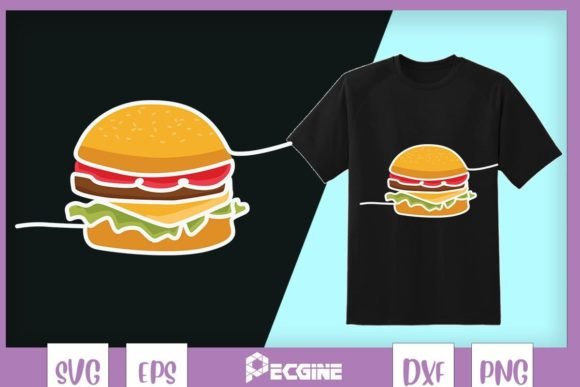
The visual style of the Burger Graphic Hamburger Art Fast Food set leans into the classic Americana aesthetic. It captures the "juicy" appeal of fast food through bold lines and distinct layers. You can see the texture in the lettuce, the shine on the bun, and the depth of the meat patty. This isn't flat, minimalist corporate art; it has personality. It evokes a sense of nostalgia and comfort, which is exactly what food branding needs to do. It tells the customer that the food is hearty, satisfying, and unpretentious.
Because of this distinct personality, the graphic acts almost like a visual anchor. In design terms, an anchor is an element that draws the eye and grounds the layout. If you are working on a menu with a lot of text, a high-quality burger illustration provides a necessary break for the eyes. It helps guide the viewer’s flow, ensuring they don’t get overwhelmed by blocks of text. The "vibe" is casual and energetic, making it perfect for brands that want to appear approachable rather than exclusive.
Strategic Applications for Brand Identity
Understanding where to deploy these assets is just as important as having them. The versatility of the Burger Graphic Hamburger Art Fast Food files makes them suitable for a wide range of applications, but context matters.
Print and Physical Collateral
For small business owners, particularly those in the restaurant industry, print is not dead. Menus, table tents, loyalty cards, and window decals are physical touchpoints that customers interact with. The DXF file included in this package is particularly useful here. DXF files are the standard for vinyl cutting machines like Cricut or Silhouette. If you want to create a physical vinyl sticker for your shop window or a custom decal for your delivery car, you can send this file directly to your cutter. This allows for a level of customization that standard printing cannot offer. You aren't just sticking a paper printout on the glass; you are creating a durable, professional sign.
Digital Presence and Social Media
In the digital realm, the transparent PNG file is your best friend. Social media marketing relies heavily on visual content. Platforms like Instagram and TikTok are crowded, and text-only posts often get scrolled past. By overlaying the burger graphic onto your photos or using it as a background element for your stories, you create immediate visual recognition. Furthermore, if you are running a website, the SVG format ensures that your graphics load quickly and look sharp on high-resolution retina displays. Fast loading times are a critical factor for SEO, and vector files are generally lighter and more efficient than high-res bitmaps.
Practical Guidance for Designers and Crafters
As a creative professional, I often see people download assets and immediately try to force them into a project without testing. Here is a more practical approach to integrating the Burger Graphic Hamburger Art Fast Food files into your workflow.
Evaluating Project Fit and Color Theory
Before you start placing the burger on every surface, look at the color palette of your existing brand. Does the illustration match? If the graphic is a vibrant, saturated red and yellow, it will clash with a pastel or earth-tone brand identity. However, because you have the vector files (SVG/EPS), you have the power to edit. You can open these files in Adobe Illustrator or Affinity Designer and change the colors to match your brand's specific hex codes. This ensures consistency across your brand identity. A cohesive color palette builds trust and makes your brand look more established.
Font Pairing and Typography
Food graphics often pair best with specific typography styles. Given the bold, retro nature of the burger art, you might want to avoid overly delicate serif fonts or formal script fonts. Instead, look for bold sans-serif typefaces or vintage-style display fonts. The graphic creates a casual, loud voice, so your typography needs to speak the same language. If you use a thin, whisper-like font next to a thick, juicy burger illustration, the visual dissonance will confuse the viewer. Aim for visual weight balance; heavy images usually require heavier text.
The Value of File Formats
It is worth noting why having multiple formats (SVG, PNG, DXF, EPS) is a significant advantage for a commercial font or asset pack.
- SVG (Scalable Vector Graphics): Best for web design and modern cutting software. It keeps file sizes small and quality high.
- PNG (Portable Network Graphics): Best for quick drag-and-drop use in social media managers or basic photo editors where you need a transparent background immediately.
- EPS (Encapsulated PostScript): The industry standard for professional print shops. If you are sending your design to a commercial printer for large-format signage, they will likely ask for this.
- DXF (Drawing Exchange Format): Essential for CAD and vinyl cutting. This ensures compatibility with hardware used by crafters and sign makers.
By having all four, you are future-proofing your purchase. You don't need to go back and convert files later; you have the right tool for the right job immediately.
Enhancing Visual Hierarchy and Engagement
Visual hierarchy is the arrangement of elements to show their order of importance. In a food-related project, the food itself is usually the most important element. The Burger Graphic Hamburger Art Fast Food asset naturally commands attention. By placing it strategically—perhaps at the top of a menu or in the center of a poster—you establish a focal point immediately. This helps organize the information around it. Customers will see the burger, get hungry, and then look for the details (price, location, ingredients).
Moreover, professional design assets signal professionalism to your audience. Even if a customer isn't a designer, they can subconsciously tell the difference between a blurry, stretched JPEG and a crisp, well-designed vector illustration. Using high-quality assets elevates your brand perception. It suggests that you care about details, which in turn implies that you care about the quality of your food or service. In a competitive market, these small psychological cues make a big difference in conversion rates.